CardiovascularNeuromodulation Lab

What We Do

The laboratory combines neural, cardiovascular, cerebrovascular, respiratory, and experimental-stressor methods.

Showing 9 of 9 techniques

Microneurography and muscle sympathetic nerve activity

A specialized method for recording bursts of nerve traffic involved in blood-vessel control.

Technical detail for Microneurography and muscle sympathetic nerve activity

Page 1 of 7

Direct recordings from peripheral nerves
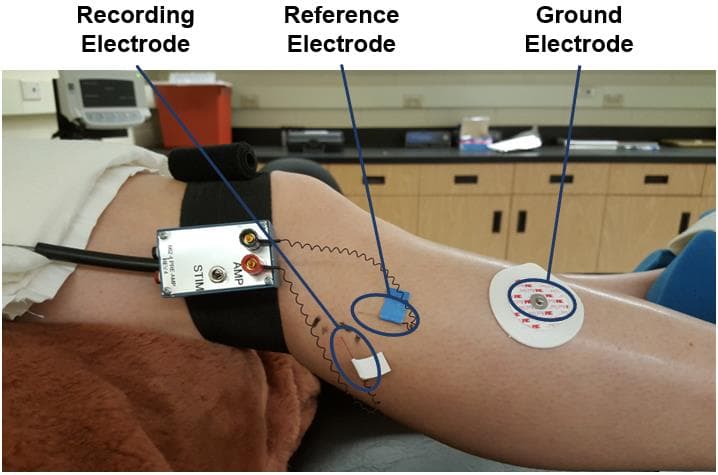
A supported lower leg with recording and reference microelectrodes connected to a head-stage amplifier and a surface ground electrode.
Microneurography recording setup at the common fibular nerve.Photograph by Dr. Anthony Incognito, University of Guelph.

Microneurography uses a fine tungsten microelectrode to record electrical activity from a peripheral nerve in a conscious participant.

We measure muscle sympathetic nerve activity (MSNA): brief nerve bursts that help control blood vessels and regulate blood pressure.

References

Page 1 of 7: Direct recordings from peripheral nerves

Beat-to-beat cardiovascular monitoring

Combines continuous blood-pressure and ECG recordings with pulse and ultrasound measurements.

Technical detail for Beat-to-beat cardiovascular monitoring

Page 1 of 5

Beat-to-beat blood pressure

Finger photoplethysmography follows the arterial-pressure waveform from beat to beat, capturing rapid changes that arm-cuff readings can miss.

Participants keep the cuffed hand supported and still. Brief pressure, numbness, or soreness can occur; the device can be adjusted or removed.

References

Page 1 of 5: Beat-to-beat blood pressure

Cerebrovascular autoregulation and reactivity

Examines how brain blood flow adapts to changes in blood pressure and respiratory gases.

Technical detail for Cerebrovascular autoregulation and reactivity

Page 1 of 2

Pressure autoregulation

Repeated squat-to-stand manoeuvres create predictable rises and falls in blood pressure. We record beat-to-beat pressure and transcranial Doppler cerebral blood-flow velocity together to examine how the brain's circulation buffers each change.

The movement pattern and monitoring period are adapted to the study and the participant.

References

Page 1 of 2: Pressure autoregulation

Ambulatory blood-pressure monitoring

A portable cuff records blood pressure at intervals during everyday activities and sleep.

Technical detail for Ambulatory blood-pressure monitoring

Autonomic function testing

Shows how the autonomic nervous system adjusts heart rate and blood pressure during breathing, straining, and changes in posture.

Technical detail for Autonomic function testing

Page 1 of 5

Deep breathing

Participants complete 10 smooth breaths over about 100 seconds: five seconds in and five seconds out, paced by a metronome or visual guide.

Continuous beat-to-beat blood pressure and ECG show how heart rate and pressure change with breathing. The test may be performed lying down, sitting, or upright, depending on the study.

  • Breathing remains smooth, without pauses between inhalation and exhalation.
  • The test stops if light-headedness or other symptoms become uncomfortable.

References

Page 1 of 5: Deep breathing

Physical and mental stress testing

Measures cardiovascular responses to physical effort, cold, mental tasks, and controlled breathing or gas challenges.

Technical detail for Physical and mental stress testing

Page 1 of 5

Static handgrip and PECO

Two or three maximal grip attempts establish a reference. Participants then hold 30 to 50% of that strength using dynamometer feedback for at least two minutes or, in some studies, until fatigue while continuing to breathe normally.

In selected studies, post-exercise circulatory occlusion (PECO) follows the handgrip. A cuff briefly restricts blood flow in the exercised arm, helping separate the muscle metaboreflex response from the effects of active contraction.

References

Page 1 of 5: Static handgrip and PECO

Functional near-infrared spectroscopy

An optical method for tracking changes in oxygen-related signals near the brain's surface.

Technical detail for Functional near-infrared spectroscopy

Virtual-reality and vestibular perturbation methods

Examines how visual motion and balance-related signals interact with cardiovascular regulation.

Technical detail for Virtual-reality and vestibular perturbation methods

Browser-based and server-based research tools

Software for research measurement, learning, and physiological data-analysis workflows.

Technical detail for Browser-based and server-based research tools